• Home
  • Shop
  • Stitch Showcase
  • Embroidery tips
  • Freebies
  • About
  • Contact
Menu

Embellished Elephant

  • Home
  • Shop
  • Stitch Showcase
  • Embroidery tips
  • Freebies
  • About
  • Contact
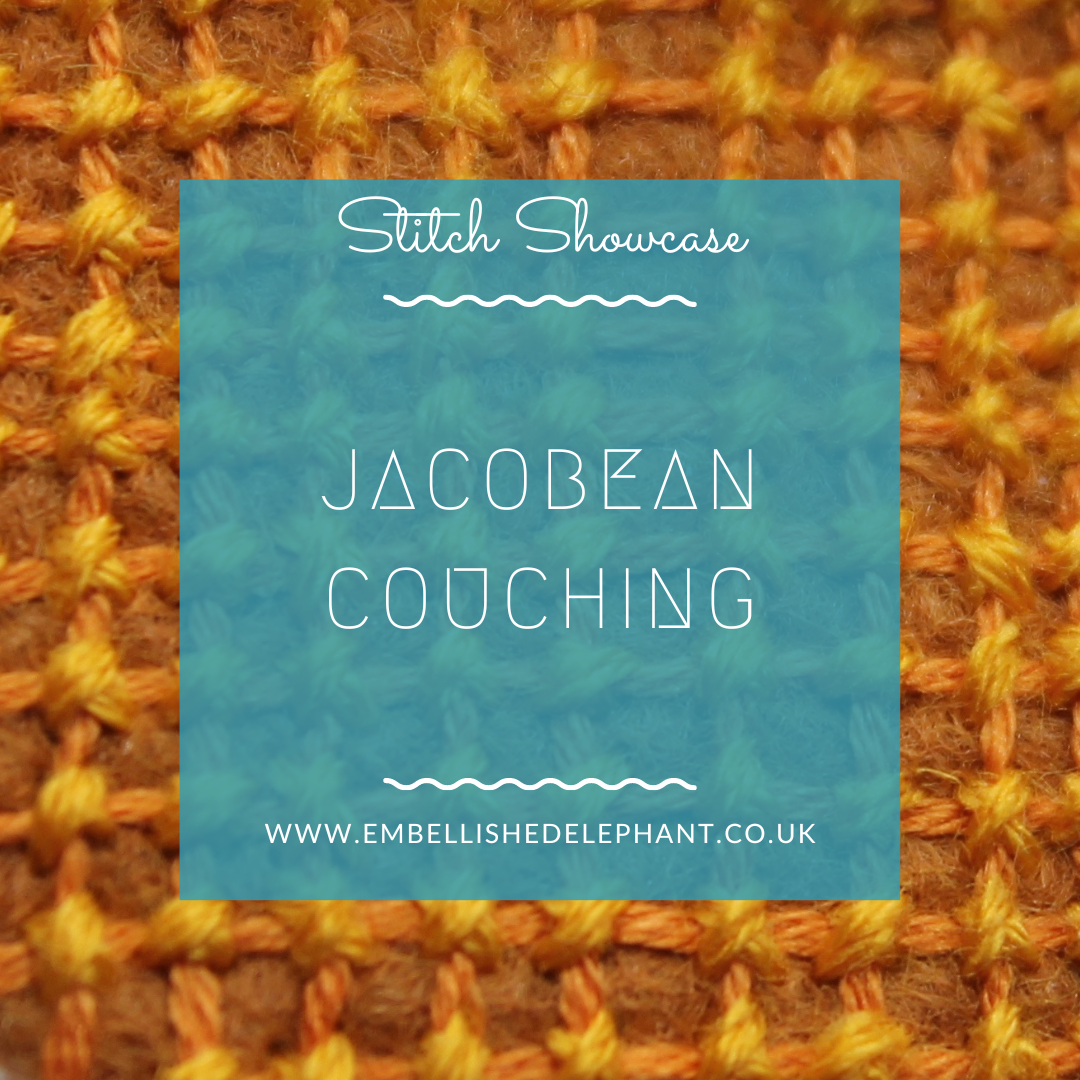
An image of jacobean couching stitch on sand coloured felt with sand and mustard threads. Overlaid is a blue square with white text saying - stitch showcase, jacobean couching, www.embellishedelephant.co.uk

Stitch Showcase: Jacobean Couching

December 30, 2020

Jacobean couching is a stitch that originated in the 17th Century and requires precision and time to get both the laid down threads and the cross stitches that couch them down lying evenly.

  • Start off by laying down the vertical threads evenly spaced across the area. (The closer together the threads the more couching you'll need to do.)

  • To help get each stitch straight lie the thread on top of the felt and get the correct angle before you complete the stitch.

  • Now repeat the same process for laying down horizontal threads. The effect looks best if these are spaced out at the same distance as the vertical threads but play around with the spacing for different effects.
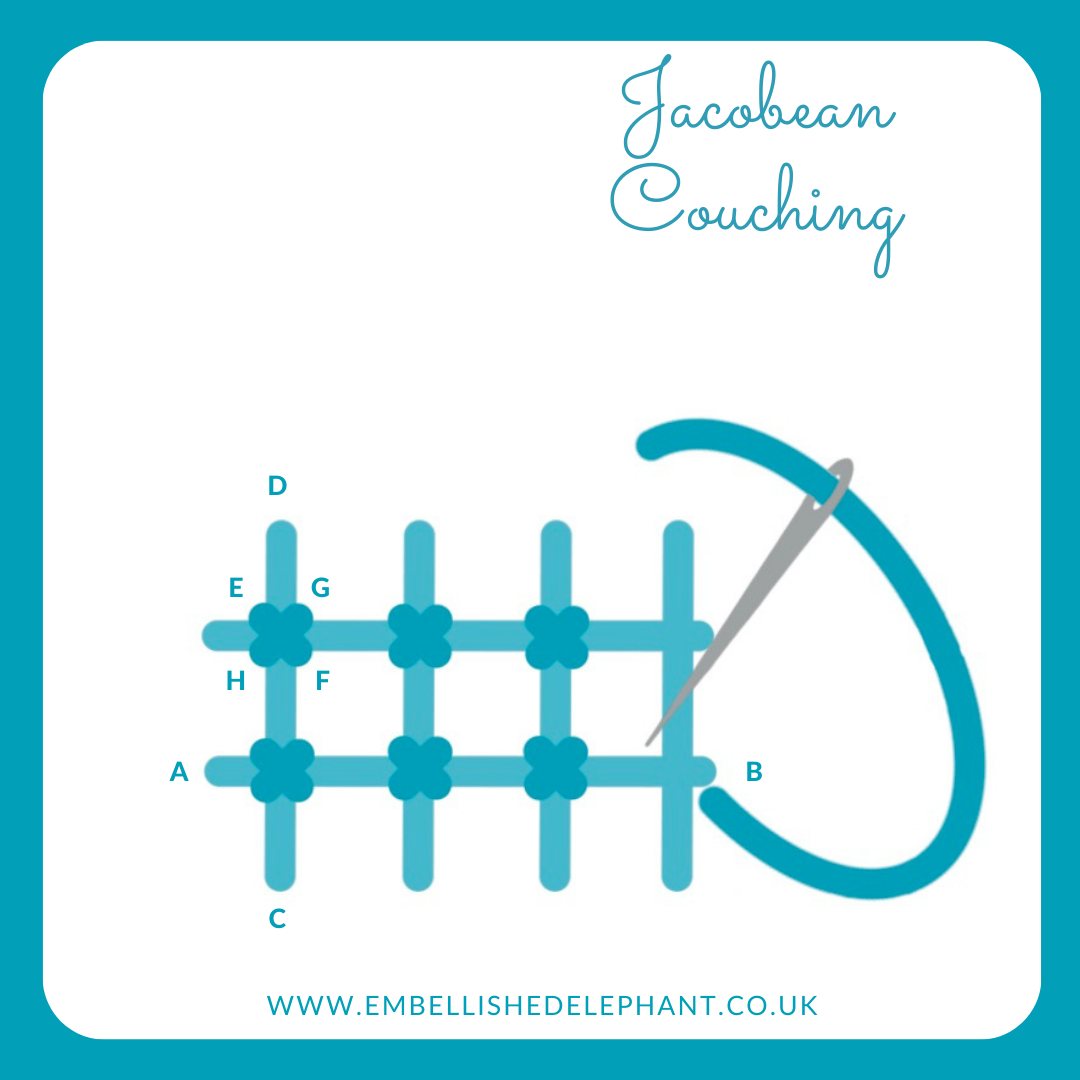
An illustration of how to create the embroidery stitch called jacobean couching. The illustration is in shades of blue and grey on a white background
  • The intersection of each vertical and horizontal thread is where a small cross stitch will be added to secure or couch the threads.

  • To add these, start by bringing the needle up at the top left of the intersection and then taking it down over the threads at the bottom right to complete a half cross stitch. To complete the cross, work from top right to bottom left.

  • My preference is to complete all the half crosses first and then go back and complete the rest of the cross, but you can complete each cross before moving on. I'd suggest you always work the first part of the cross in the same direction for the best finish.

  • You can work methodically from one side to another. Alternatively work every few stitches on each row to tack the threads in place which helps maintain the even spacing, before going back and filling in the gaps.

This is a great stitch to experiment with different thread thicknesses and colour combinations. The sample below is stitched with one strand of embroidery floss and a single strand of metallic sewing thread.

Want to try this stitch? It’s one that I suggest using in my monstera kit.

Enjoyed this blog post? I share embroidery tips and a free embroidery pattern in my monthly newsletter. Sign up here to receive the newsletter on the 1st of each the month.

In stitch showcase 1 Tags Stitch Showcase, Couching Stitch
← Stitch Showcase: Bullion KnotSix techniques for embellishing with sequins →
No results found

Tags

  • Artists/Designers
  • Basics
  • Christmas
  • colour
  • Couching Stitch
  • Fabric
  • Filling Stitch
  • Finishing
  • Hoops
  • Isolated Stitch
  • Line Stitch
  • London
  • My Makes
  • Needles
  • Raised Stitch
  • Stitch Showcase
  • Texture Stitch
  • Thread
  • Transfer
  • Travel

Latest Posts

Featured
June 1, 2026
Focus on knots
June 1, 2026
June 1, 2026
May 1, 2026
Focus on stranded floss
May 1, 2026
May 1, 2026
April 1, 2026
Focus on raised stitches
April 1, 2026
April 1, 2026
February 15, 2026
Tips for unpicking thread tangles
February 15, 2026
February 15, 2026
February 1, 2026
How to add elements to a basic embroidery pattern
February 1, 2026
February 1, 2026
December 1, 2025
Using yarn in embroidery
December 1, 2025
December 1, 2025
November 1, 2025
What can you learn from vintage embroidery books
November 1, 2025
November 1, 2025
September 1, 2025
What is the difference between cross stitch and embroidery?
September 1, 2025
September 1, 2025
July 1, 2025
How to make time for embroidery
July 1, 2025
July 1, 2025
June 1, 2025
What is stranded embroidery thread?
June 1, 2025
June 1, 2025

Home — Shop — Stockists — Wholesale — Portfolio — Contact — Reviews — Policies — FAQs